
2025 Summary of Legal Industry Salary Trends in Australia
If you're trying to make sense of where your law firm stands in today’s market, or how to stay competitive in attracting and retaining top talent, the right salary data is essential. With multiple legal salary reports released each year, it’s easy to get overwhelmed. That’s why we’ve broken down the three major 2025 guides: ALPMA, Empire Group, and Hays, to show you exactly what you need to know.
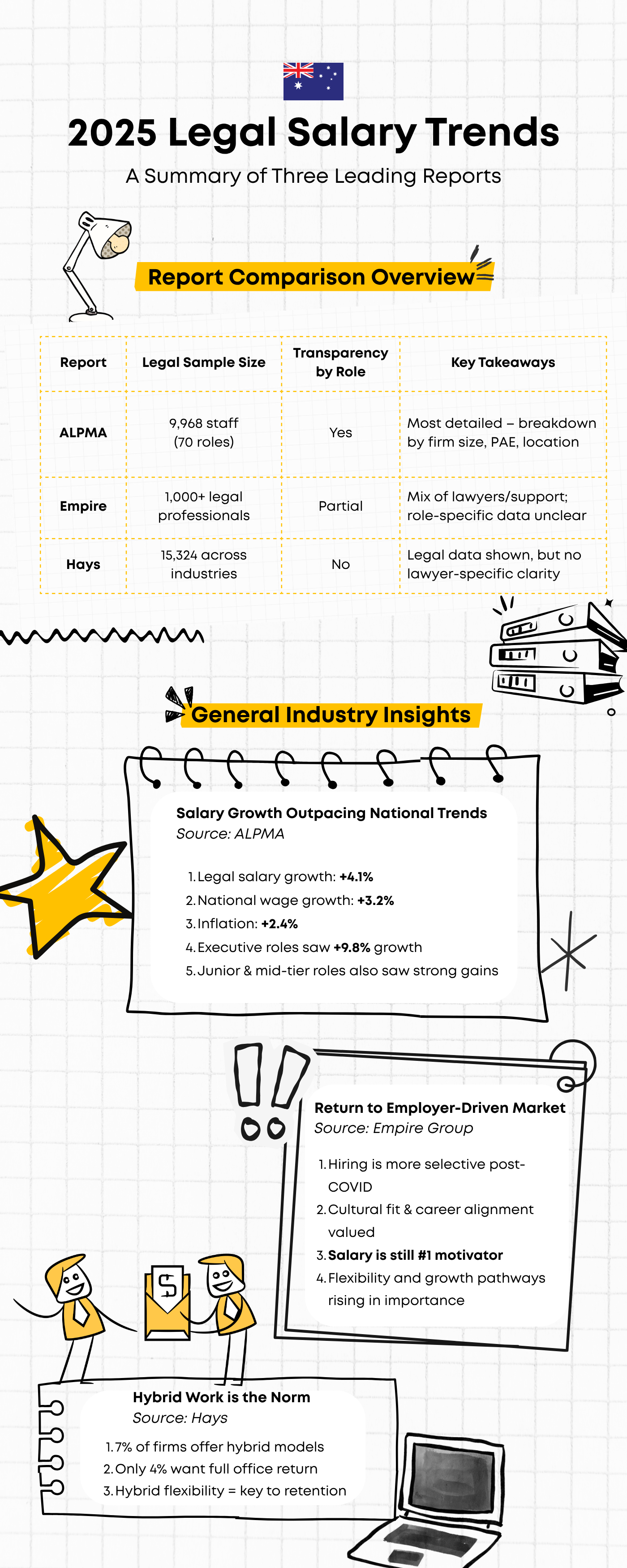
This side-by-side comparison cuts through the noise to highlight transparency, sample sizes, salary ranges, and key industry insights. Whether you're benchmarking pay for graduate lawyers or evaluating senior roles like Special Counsel or Partner, this guide will help you make smarter, data-driven decisions. Let’s dig in and see what the numbers are really telling us about the legal landscape in 2025.
About the Three Guides Summarised
Each report provides details on the sample size, including how many lawyers or legal professionals were surveyed. Here's a breakdown from each document:
1. ALPMA 2025 Legal Industry HR Issues and Salary Survey
Total respondents:
345 legal offices across AustraliaStaff covered:
9,968 legal staffacross70 rolesSpecific lawyer data examples:
287 salaries collected for Graduate Lawyers
Detailed counts are provided per position, where available
Comment:
ALPMA provides the most detailed and statistically transparent methodology, including standard deviations, medians, and breakdowns by firm size, state, and location.
2. Empire Group Legal Salary Guide 2025/26
Total responses:
1,000+ professionals from the legal sectorIncludes:
Both legal professionals and legal support staffComment:
The survey covers a wide cross-section nationally and is supported by insights from Empire’s recruitment consultants. However, it doesn't specify how many of the 1,000+ were lawyers vs support staff.
3. Hays Salary Guide FY24/25
Total survey responses:
15,324 professionalsacross26 industriesLegal-specific sample:
Hays does not specify the exact number of legal professionals surveyed.Comment:
The legal section includes detailed tables for roles and locations, but lacks transparency about the legal-specific sample size. Data is broad and multi-industry.
Summary Comparison

General Industry Insights
Salary Growth is Softening but Still Outpacing National Averages (ALPMA):
Average salary growth across legal roles in 2025:4.1%
This outpaces national wage growth (3.2%) and inflation (2.4%), indicating real wage gains.
Most significant increases were for Executive/Senior Management roles (+9.8%), with strong growth for junior and mid-tier lawyers.
Return to Employer-Driven Market (Empire Group):
Aggressive post-COVID hiring and salary spikes have stabilised.
Employers are now more selective, focusing on cultural fit, long-term value, and career alignment.
Salary remains the #1 motivator for job changes, but factors like flexibility and career progression are gaining importance.
Hybrid Work is Standard – Not Negotiable (Hays):
97% of organisations offer some form of hybrid working.
Only 4% of employees want a full return to the office.
Hybrid flexibility and workplace culture are top factors in employee retention.
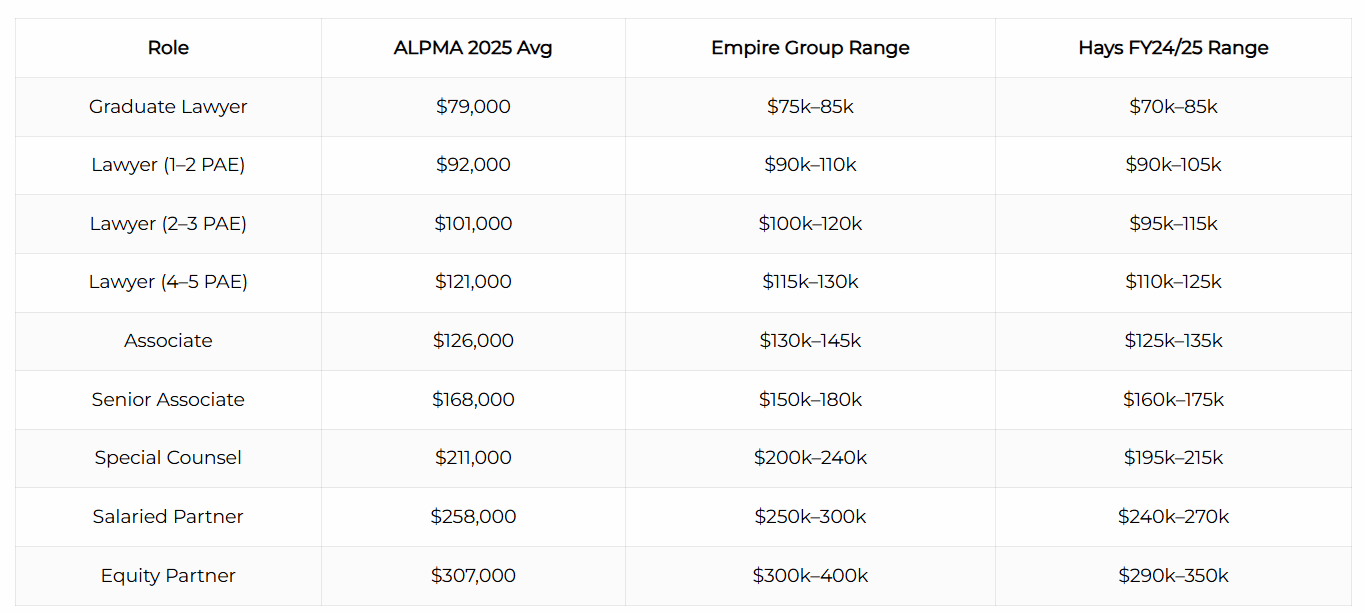
Key Salary Trends by Role
Trends by Firm Size & Location (ALPMA)
Small Firms typically pay ~10–15% less than large firms for most roles.
QLD salaries are slightly below the national median for early-career lawyers but remain competitive in partner and senior roles.
ACT and WA report the highest median graduate lawyer salaries.
Salary compression at mid-level (3–6 years PAE) is narrowing, rewarding retention and early promotions.
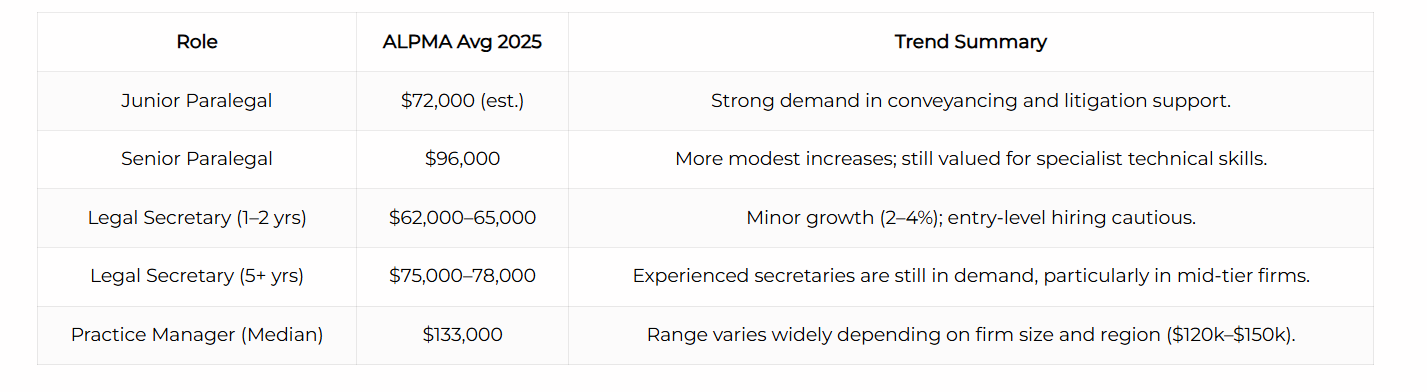
Support Roles
Other Influencing Factors
From All Three Reports:
Flexibility: Firms offering remote work and autonomy attract and retain better talent.
Leadership: 60% of candidates say supportive and transparent leadership is vital.
Workplace Culture: A primary retention factor; leadership, communication, and empathy are highly valued.
Career Pathways: Clear progression is the second-biggest reason for role changes.
Final Takeaway
While salary growth is no longer spiking as it did post-pandemic, the legal sector remains competitive, especially for junior and mid-career lawyers. Employers are advised to balance competitive remuneration with meaningful career development, flexibility, and a strong internal culture.
